Section 1 – Why california EV charging hotel mandate compliance is now a boardroom issue
California EV charging hotel mandate compliance has moved from optional amenity to hard requirement. For hotel groups planning new properties or major renovations in california, the building code now defines how much charging, parking and electrical infrastructure must be delivered on day one. This shift directly affects portfolio positioning, capital allocation and long term mobility partnerships.
Under CALGreen, the California Green Building Standards Code, new hotels must design at least 40% of total parking spaces as EV ready, with 10% equipped with installed chargers capable of level charging at opening. That means every new parking lot or structured garage is now a regulated asset, not just a neutral space for vehicles. For airport hotels, rail adjacent properties and transfer hubs, the mandate reshapes how parking spaces, charging stations and guest access are planned around peak arrival waves.
The adoption gap is already visible across the market, with roughly 26% of U.S. hotels offering some form of electric vehicle charging station while luxury properties approach 90% penetration and limited service properties sit near 20%. California EV charging hotel mandate compliance will accelerate this divergence if owners under invest in charging equipment during construction and then face retrofit costs later. For mobility focused brands, vehicle charging is becoming as defining as Wi Fi quality or airport shuttle frequency.
Section 2 – Translating CALGreen requirements into parking lot design and guest experience
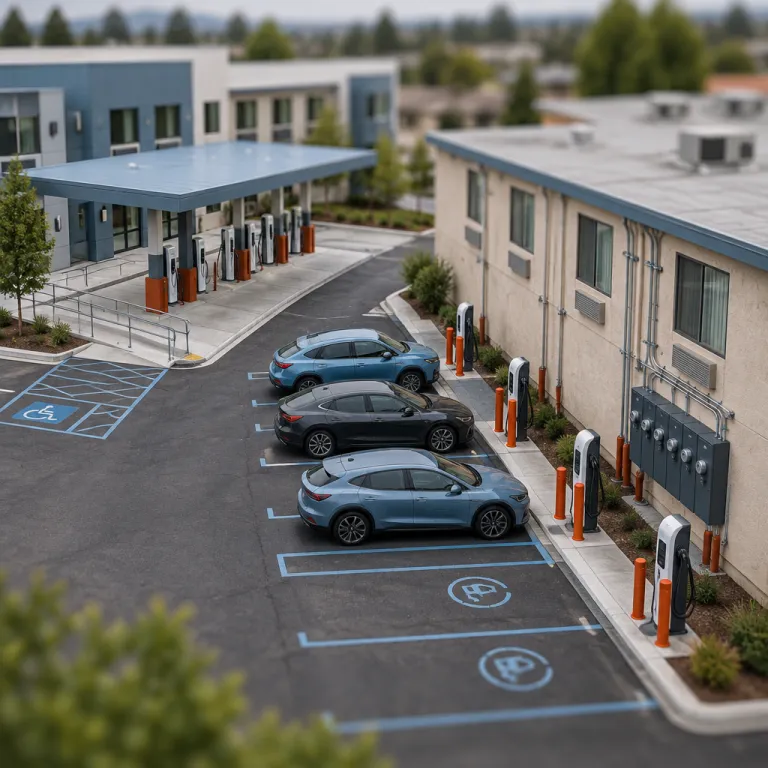
For development and asset teams, the practical question is how to translate CALGreen requirements into a coherent parking lot layout that works for guests, staff and transfer partners. California EV charging hotel mandate compliance starts with a full inventory of planned parking spaces, including valet, self parking, accessible parking and dedicated fleet areas. From there, designers must allocate the mandated share of charging spaces, accessible charging bays and EV ready conduits without fragmenting the guest journey.
In practice, that means grouping a critical mass of charging space locations near primary entrances, shuttle pick up zones and ride hail staging areas, rather than scattering single chargers across the property. Hotels serving airports and rail stations should align charging infrastructure with their transfer choreography, so an electric shuttle can use a charging station while guests check in or dine. For mobility platforms and travel managers, this layout determines whether electric vehicle fleets can turn around quickly between airport runs or remain blocked by combustion engine cars occupying a parking space in front of a charger.
Design teams also need to integrate clear wayfinding, pavement markings and a consistent sign strategy so guests understand which parking spaces are reserved for vehicle charging and which remain general use. This is where california EV charging hotel mandate compliance intersects with sustainable transport to hotel strategies, as described in guidance on eco friendly transport to hotel and sustainable mobility for hospitality. When charging equipment, parking lots and guest communications are aligned, EV drivers experience the property as intentionally designed for electric mobility rather than retrofitted under regulatory pressure.
Section 3 – Electrical infrastructure, building code and the real costs of installing charging
The most expensive mistakes in california EV charging hotel mandate compliance happen behind the walls, not in the parking lot. Electrical infrastructure decisions taken during schematic design and value engineering will determine whether installing charging equipment later costs a manageable premium or a painful multiple. Integrating EV ready capacity into the building code compliance strategy is now as critical as sizing HVAC or lifts.
For new properties, engineers should model several adoption scenarios, from baseline CALGreen requirements to higher EV penetration driven by corporate travel policies and airline or rail partnerships. Designing main switchboards, transformers and distribution panels for this future load allows property owners to phase in additional charging stations without tearing up finished parking spaces or upgrading undersized feeders. Federal incentives under the Inflation Reduction Act can offset up to 30% of eligible costs for EV charging equipment and installation, capped per charging station, when prevailing wage conditions are met.
State level programmes in california, New York and Massachusetts add further support, but they all assume that the underlying electrical infrastructure can handle the load. For hotel groups tracking Scope 3 emissions from guest and staff travel, EV ready design also simplifies reporting under frameworks explained in resources on measuring and reporting transportation carbon footprint in hospitality. When the building code, charging infrastructure and carbon accounting are aligned, vehicle charging becomes a strategic asset rather than a compliance headache.
Section 4 – From airport apron to parking space: integrating EV charging into multimodal arrivals
California EV charging hotel mandate compliance does not exist in isolation from the rest of the journey. For airlines, rail operators and mobility platforms, the hotel parking lot is now part of a multimodal electric corridor that starts at the airport apron or station platform. Guests increasingly expect that an electric vehicle used for the transfer will have reliable access to a charging space at the hotel, especially on longer itineraries.
Forward looking properties are mapping their parking spaces and charging stations against flight banks, train timetables and coach arrivals to avoid bottlenecks. An airport hotel might reserve a cluster of charging spaces for electric shuttles and ride hail partners during peak evening arrivals, then release them to guests overnight through digital access controls. Rail adjacent properties can coordinate with operators so that electric taxis and shared vehicles have priority access to accessible charging bays when high speed trains arrive with a surge of business travellers.
For travel managers, this integration matters because it affects duty of care, schedule reliability and perceived sustainability of the entire trip. A corporate traveller who lands late, finds the transfer waiting and sees a clearly marked sign for vehicle charging at the hotel will rate the experience very differently from one who circles a crowded parking lot searching for a compatible charger. Guidance on the hotel folio as a map of the journey from airport to room shows how these transport touchpoints now influence both guest satisfaction and ancillary revenue.
Section 5 – Business models, tariffs and partnerships around charging infrastructure
Once california EV charging hotel mandate compliance is secured on paper, the commercial work begins. Property owners must decide whether charging equipment is a pure guest amenity, a revenue generating asset or a platform for partnerships with airlines, rail companies and mobility providers. The answer will shape tariffs, access rules and long term contracts for operating charging infrastructure across the portfolio.
Some properties choose to offer complimentary level charging for elite loyalty members or premium cabin passengers arriving on partner airlines, while charging other guests a transparent per kilowatt hour rate. Others structure revenue share agreements with charging networks that install and operate chargers on site, reducing upfront costs but ceding some control over pricing and data. For hotels with large parking lots near airports or stations, there is also an opportunity to monetise daytime parking spaces by offering electric vehicle charging to commuters and ride hail drivers when in house demand is low.
Whatever the model, clarity is essential around who can access each charging space, how long a vehicle can remain in a parking space after charging completes and what penalties apply for blocking accessible parking or EV only bays. California EV charging hotel mandate compliance provides the minimum standards, but competitive differentiation comes from thoughtful service design and transparent communication. Over time, the most successful properties will treat charging stations as part of a broader mobility ecosystem, not just another line item in the utilities budget.
Section 6 – Renovations, retrofits and future proofing existing properties
Existing hotels facing major renovations sit in a more complex position than new builds under california EV charging hotel mandate compliance. Retrofitting charging infrastructure into constrained urban parking lots or historic properties can be technically challenging and capital intensive. Yet delaying action risks stranded assets, lost corporate contracts and misalignment with airline or rail sustainability commitments.
A pragmatic roadmap starts with a detailed audit of current parking spaces, electrical infrastructure and guest demand patterns, including the share of arrivals already using electric vehicles. From there, owners can prioritise low disruption wins such as installing charging equipment in underused corners of the parking lot, then plan phased upgrades to main panels and feeders as part of broader building code compliance projects. In some cases, it may be more efficient to re stripe the parking lot to create fewer but better located charging spaces, especially where accessible charging and accessible parking requirements intersect.
For portfolio level decision makers, the key is to standardise technical specifications, signage and service levels across properties so that guests and mobility partners experience consistent vehicle charging options. California EV charging hotel mandate compliance then becomes a baseline that supports brand wide sustainability narratives and transport partnerships, rather than a patchwork of one off projects. Over the long term, hotels that integrate EV ready design into every renovation will be better positioned to adapt as regulations, guest expectations and electric vehicle adoption continue to accelerate.
Key figures shaping hotel EV charging strategies
- Approximately 26% of U.S. hotels currently offer some form of EV charging, while close to 90% of luxury properties provide chargers compared with around 20% of limited service hotels, highlighting a significant adoption gap between segments.
- CALGreen requires new hotels in California to make at least 40% of parking spaces EV ready, with 10% equipped with installed Level 2 chargers at opening, which materially increases the share of regulated parking spaces in new developments.
- Federal incentives under the Inflation Reduction Act can cover up to 30% of eligible EV charging equipment and installation costs, capped at USD 100,000 per charger, for projects that meet prevailing wage requirements, substantially improving project ROI.
- State level programmes such as those in New York, Massachusetts and California can add between 50% and 60% additional funding or rebates per charging port, which can reduce net capital expenditure for hotel property owners by more than half in some cases.
- In Europe, the Alternative Fuels Infrastructure Regulation will require ISO 15118 support for vehicle to grid capable public chargers and payment card readers on all fast chargers, signalling that interoperability and payment simplicity will become global standards that U.S. hotels must anticipate.
FAQ – california EV charging hotel mandate compliance
What does CALGreen require from new hotels in terms of EV charging ?
CALGreen, the California Green Building Standards Code, requires new hotel projects to make at least 40% of total parking spaces EV ready, with conduit and capacity in place, and to install Level 2 chargers in at least 10% of those spaces at opening. These requirements apply to both surface parking lots and structured garages associated with the property. The goal is to ensure that charging infrastructure can scale as electric vehicle adoption grows without costly retrofits.
How should hotel owners budget for EV charging installation in new builds ?
Hotel owners should integrate EV charging installation into the core electrical design and construction budget rather than treating it as a separate add on. This means sizing transformers, switchgear and distribution panels for future charging stations, which is typically three to five times cheaper than upgrading after construction. Owners should also factor in available federal tax credits and state rebates that can offset a significant share of charging equipment and installation costs.
What are best practices for locating charging spaces in a hotel parking lot ?
Best practice is to cluster charging spaces near main entrances, accessible routes and shuttle or ride hail pick up zones, rather than scattering single chargers across the parking lot. Hotels should reserve some charging spaces for fleet and partner use, especially at airport and rail adjacent properties where transfer vehicles need reliable access. Clear signage, pavement markings and digital information in booking and pre arrival communications help guests understand where to park and how long they can remain in a charging space.
How can existing hotels approach california EV charging hotel mandate compliance during renovations ?
Existing hotels should begin with an audit of current parking spaces, electrical capacity and guest demand for EV charging, then develop a phased plan aligned with upcoming renovation cycles. Early steps often include installing a limited number of chargers in the most strategic parking spaces and upgrading panels or feeders when other building code work is already planned. Over time, owners can re stripe parking lots, add more charging stations and standardise signage and service levels across properties to meet both regulatory requirements and guest expectations.
What role do airlines, rail operators and mobility platforms play in hotel EV charging strategies ?
Airlines, rail operators and mobility platforms influence hotel EV charging strategies through their sustainability commitments, fleet choices and corporate travel policies. When these partners shift airport shuttles, station transfers or ride hail fleets to electric vehicles, hotels must ensure that parking spaces and charging stations can support reliable operations. Strategic partnerships can include reserved charging spaces, shared investment in charging infrastructure and integrated booking or payment solutions that create a seamless experience from aircraft or train to hotel room.