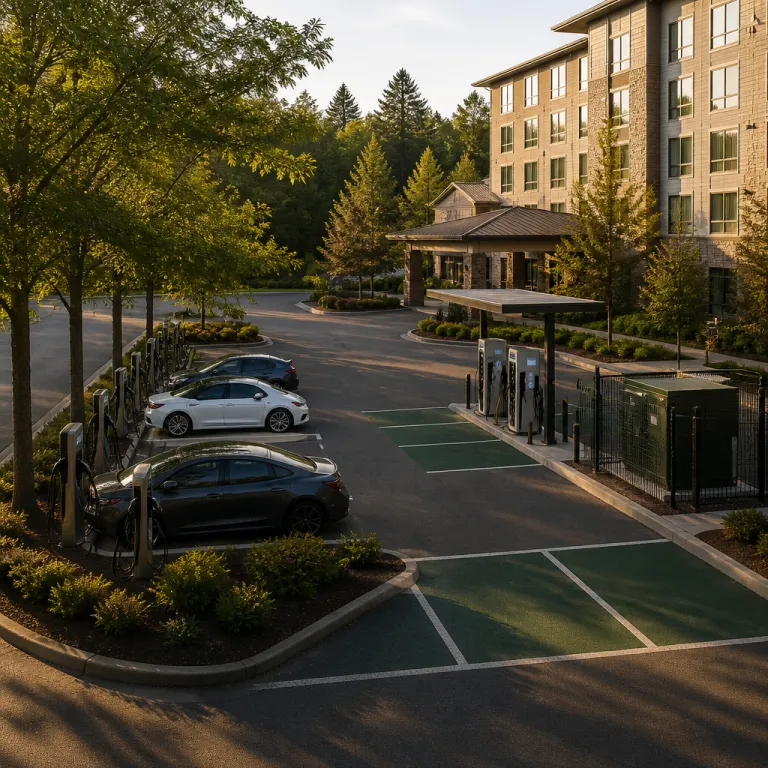
Section 1 – Why hotel EV charging station planning is now a core mobility strategy
Hotel EV charging station planning has moved from “nice amenity” to core mobility infrastructure. For hospitality properties that sit in the airport, rail, and transfer ecosystem, hotel charging now shapes which hotels driving guests, airline crews, and rail passengers actually book. In a 2023 survey by J.D. Power on hotel guest satisfaction, 81% of EV drivers said charging availability influences their choice of hotel, and multiple industry polls report that more than 90% of EV owners are more likely to stay at a property that offers on-site charging, with a clear majority willing to pay a premium for the convenience. The business case is no longer theoretical.
For hotel management teams and travel managers, the question is not whether to install a charging station, but how many charging stations, what type of charger mix, and how to phase the charging infrastructure over the long term. A practical planning benchmark emerging from industry data is to equip a small but scalable share of parking spaces with chargers today and to design the electrical backbone so that roughly one in five bays can support EV charging by 2030. That trajectory gives hotels charging capacity that matches current electric vehicle penetration while leaving room for growth as more visitors arrive in EVs.
In practice, this means a 100-room hotel with 80 guest parking spaces might start with four to six charging stations, while a 400-room airport hotel with 300 parking spaces should already be planning for 15 to 20 chargers. Those chargers must be integrated into the wider mobility service stack that includes airport shuttles, rail connections, and ride hail pick up zones, so that EV drivers can charge while they sleep, attend meetings, or wait for delayed flights. Hotel EV charging station planning therefore becomes a cross-functional exercise involving hotel management, electrical engineers, EV charging vendors, and mobility partners who all support the same seamless arrival experience.
Section 2 – Sizing the charger mix for 50 to 500 rooms
Once a hotel commits to vehicle charging, the next decision is sizing the mix of level charging and fast charging for 50 to 500 rooms. Level 2 overnight charging typically covers the standard guest stay of 8 to 12 hours for a full charge, which makes it the backbone of hotel chargers in most markets. DC fast chargers, by contrast, serve day visitors, event attendees, and short-stay guests who need a quick top-up before driving back to the airport or rail station.
For a 50 to 150 room property, hotel EV charging station planning usually prioritises four to eight Level 2 chargers in the main guest parking area, with one shared DC fast charging station only if the hotel has strong meeting or restaurant traffic. Between 150 and 300 rooms, hotels’ charging strategies often move to 10 to 20 Level 2 chargers, plus two fast chargers positioned near the entrance for high-churn visitors. Above 300 rooms, especially at airport hotels or stations hotels near major rail hubs, a mixed portfolio of 20 to 40 Level 2 chargers and three to six fast chargers becomes realistic, provided the electrical infrastructure and billing systems can keep pace.
The table below summarises typical starting points for charger counts by room band, assuming 0.6 to 0.8 parking spaces per room, average guest dwell times of 8 to 12 hours, and a planning horizon that anticipates significantly higher EV penetration by 2030:
Illustrative charger planning by hotel size
50–150 rooms: 4–8 Level 2 chargers, optional 1 DC fast charger (if strong local traffic)
150–300 rooms: 10–20 Level 2 chargers, plus 2 DC fast chargers near main access points
300–500 rooms: 20–40 Level 2 chargers, plus 3–6 DC fast chargers for fleets and short stays
Concrete project data illustrates how this plays out. A 220-room business hotel near a major European rail hub installed 16 Level 2 ports and two 100 kW DC fast chargers at a total turnkey cost of roughly EUR 220,000, based on 2022–2023 European pricing that included hardware, civil works, and software. Within 18 months, average nightly utilisation of the Level 2 chargers reached 68%, with fast chargers used mainly by taxis and ride hail fleets during daytime peaks. For mobility partners such as airlines, rail operators, and transfer platforms, this sizing logic matters because it determines whether their guests can reliably charge during a layover or conference. When these partners negotiate preferred hotel charging agreements, they increasingly ask not just “do you have a charger” but “how many hotel chargers, what power level, and what uptime do you guarantee”. This is where forward-looking collaborations, such as the autonomous mobility experiments analysed in the Accor – Citroën – JCDecaux autonomous hospitality bet, foreshadow a future in which charging hotels are tightly integrated with on-demand electric shuttles and station-based fleets.
Section 3 – Electrical infrastructure, load management, and grid ready design
Behind every elegant charging hotel experience sits a very physical constraint: the electrical panel and the local grid connection. Hotel EV charging station planning starts with a rigorous load assessment to understand how much spare capacity exists once kitchens, HVAC, laundry, and lifts have been accounted for. Electrical engineers then model different charging infrastructure scenarios, using load assessment software and electrical design tools to test how 10, 20, or 40 chargers will behave on a busy evening when occupancy peaks at 65 percent.
California’s CALGreen building code offers a glimpse of where regulations are heading. The 2022 CALGreen Nonresidential Mandatory Measures (Section 5.106.5.3) require that 40% of parking spaces in new hotels be EV capable (with raceway and panel capacity installed), and that at least 10% of spaces be equipped with Level 2 EV supply equipment from day one. With Level 2 chargers costing roughly USD 3,000 to 4,000 per port and DC fast chargers costing 20 to 30 times more in many North American and European projects, smart load management becomes non-negotiable. The key techniques are dynamic load balancing across all charging stations, scheduled charging windows that shift some vehicle charging to off-peak hours, and demand response enrolment that lets utilities temporarily reduce charger power in exchange for tariff benefits.
For properties that want to reduce grid dependence, pairing charging stations with on-site solar and batteries is increasingly attractive, especially in sun-rich markets. A solar plus storage system can pre-charge batteries during the day and then feed hotel chargers in the evening, smoothing peaks and protecting the main electrical infrastructure. The operational and financial logic of this approach is explored in depth in analyses of solar plus battery EV charging at hotels, which show how hospitality properties can turn guest parking into a resilient, revenue-generating asset.
Section 4 – Where to place charging stations in the guest journey
Location decisions for charging stations are as much about service design as about kilowatts. Guests remember whether the charging station was easy to find, whether the charger worked on the first tap, and whether the driver of the airport shuttle knew exactly which bays were reserved for EVs. For travel managers and mobility platforms, these details determine whether they can confidently route driving guests to a given hotel without worrying about last-minute complaints.
For 50 to 200 room hotels, the most effective pattern is to place Level 2 hotel chargers in visible, well-lit guest parking zones close to the main entrance, but not so close that non-EV visitors are tempted to occupy them. Clear ground markings, signage at the parking entrance, and wayfinding in the booking confirmation email all help guests fill those bays correctly. In larger hotels’ charging layouts, especially at stations hotels near airports or rail hubs, it often makes sense to create a dedicated EV zone that combines Level 2 chargers for overnight guests with a small cluster of fast chargers for taxis, ride hail drivers, and short-stay visitors.
Accessibility and safety are non-negotiable: charging stations must be reachable without complex ramps, with enough space for drivers to manoeuvre and connect cables in bad weather. In one anonymised North American airport hotel project, relocating chargers from a rear service yard to a well-lit front parking row increased nightly EV sessions by more than 40% and cut guest complaints to near zero. For airline crews arriving late at night, a charging hotel that offers a well-lit, camera-monitored EV zone with clear signage and 24/7 support will feel materially different from a property that hides its lone charger behind the loading dock. Over time, these micro experiences accumulate into a reputation that either attracts or repels EV-owning guests, and that reputation will be reflected in both guest reviews and corporate RFPs.
Section 5 – Business models, billing, and guest facing experience
Once the physical charging infrastructure is in place, the next layer of hotel EV charging station planning is commercial. Hotels must decide whether to offer free charging as a loyalty perk, to charge per kilowatt hour, per session, or per hour of parking, and how to integrate billing into existing property management and payment systems. The most successful hospitality properties treat EV charging as a flexible revenue and retention lever, not a rigid fee line.
For transient leisure guests, a simple per kilowatt hour tariff with transparent pricing in the booking flow works well, especially when bundled with parking fees. Corporate contracts and airline crew agreements, by contrast, often prefer flat nightly rates that include both the room and a guaranteed charge, simplifying expense reporting for travel managers. Whatever the model, the payment journey must be seamless: guests should be able to start a charge via room key, app, RFID card, or contactless bank card, with billing data flowing cleanly into the hotel’s PMS and CRM for later analysis.
Operationally, hotels’ charging operations benefit from clear policies on idle fees, maximum charging durations, and how to handle non-guest visitors who want to use the chargers. Some properties reserve a subset of hotel chargers for in-house guests only, while leaving a few fast chargers open to public use to attract local drivers and ride hail fleets. As one industry FAQ puts it without ambiguity: “How many charging stations should a hotel install? Plan for a modest initial share of parking spaces to have chargers, with a roadmap toward roughly one in five bays by 2030. What types of chargers are suitable for hotels? Level 2 chargers are standard; DC fast chargers may be added based on demand. How to manage increased electrical load? Implement load management systems and coordinate with utilities.”
Section 6 – Phased rollout, data driven scaling, and integration with MaaS
For most hotels, especially in the 50 to 250 room range, the smartest path is a phased rollout rather than a one-time build-out of every future charging station. The technical best practice is to install conduit and panel capacity for 100% of the target stations upfront, but to deploy only 25 to 50% of the physical chargers initially. Over the next two to three years, real utilisation data from guests, visitors, and fleet partners then guides when and where to add more chargers.
This approach aligns capital expenditure with actual demand while keeping options open for new charger models, better software, or changing regulations. It also creates space to integrate EV charging into broader Mobility as a Service strategies, where hotel guests can see and book airport shuttles, rail connections, and EV car share in a single interface. Case studies of MaaS integration in hotel booking flows show how powerful it is when a guest can reserve both a room and a guaranteed charging station slot in the same transaction.
For airlines, rail operators, and transfer platforms, partnering with hotels that follow this disciplined, data-driven hotel EV charging station planning framework reduces friction across the entire door-to-door journey. They can route electric vehicle fleets to properties where they know the charging solutions are reliable, the guest parking is properly signed, and the support teams are trained to handle both technical and service issues. As EV adoption in the United States heads toward tens of millions of vehicles on the road, the hotels’ charging landscape will increasingly separate into those that treated charging infrastructure as a strategic mobility asset and those that treated it as a token amenity.
Key figures for hotel EV charging and mobility
- Projections from the US Department of Energy’s Vehicle Technologies Office and National Renewable Energy Laboratory scenarios indicate that the US light-duty EV fleet could reach roughly 30 million vehicles by 2030, which will dramatically increase demand for hotel charging capacity at both urban and highway corridor properties. These figures are based on national fleet modelling that assumes continued policy support and declining battery costs.
- Average hotel occupancy in the United States sits around 65 percent according to Statista and STR benchmarking data, meaning that even a modest share of EV-owning guests can quickly saturate a small number of chargers during peak nights.
- Industry guidance suggests that hotels should equip a small fraction of parking spaces with chargers today and scale toward roughly 20 percent by 2030, a trajectory that aligns with both EV adoption curves and emerging building codes.
- CALGreen regulations in California require 40 percent of parking spaces in new hotels to be EV ready (EV capable or EV ready with raceway and panel capacity), with 10 percent fitted with Level 2 chargers, setting a regulatory benchmark that other jurisdictions are beginning to study.
- Level 2 chargers typically cost between USD 3,000 and 4,000 per port to install in many North American case studies, while DC fast chargers can cost 20 to 30 times more depending on power level, trenching requirements, and utility upgrades, which is why most hotels prioritise Level 2 for overnight guests and use fast chargers selectively for high-churn visitors.
FAQ – Hotel EV charging station planning
How many EV charging stations should a hotel with 100 rooms install first?
A 100 room hotel usually has between 60 and 100 parking spaces, and applying a conservative initial deployment rule means starting with four to six Level 2 chargers. This initial deployment should be paired with conduit and electrical capacity for at least 15 to 20 future chargers. Monitoring utilisation over the first 12 to 24 months then indicates whether to accelerate toward that higher number.
What is the right mix of Level 2 and DC fast chargers for larger hotels?
For 300 to 500 room properties, especially near airports or rail stations, a typical mix is 20 to 40 Level 2 chargers for overnight guests and three to six DC fast chargers for day visitors, taxis, and ride hail fleets. Level 2 chargers handle the bulk of energy delivered because guests are parked for many hours. Fast chargers are reserved for short dwell vehicles where time is more valuable than energy cost.
How should hotels manage the impact of EV charging on their electrical systems?
Hotels should begin with a professional load study that maps existing consumption and spare capacity on the main panel. Smart load management systems can then dynamically allocate power across all chargers, reduce power during building peaks, and schedule some charging to off-peak hours. Coordination with the local utility is essential to secure any necessary upgrades and to enrol in demand response programmes where available.
What pricing and billing models work best for hotel EV charging?
Most hotels use either per kilowatt hour pricing or a hybrid model that combines a session fee with time-based parking charges, while some upscale properties offer complimentary charging to loyalty members. The key is to make pricing transparent in the booking flow and at the charger, and to integrate billing with the PMS so that charges appear on the room folio. Corporate and airline contracts often prefer bundled nightly rates that include both parking and charging.
How can airlines, rail operators, and transfer platforms collaborate with hotels on EV charging?
These mobility actors can include EV charging availability and capacity as criteria in their preferred hotel programmes and RFPs, ensuring that partner properties have enough chargers and the right mix of power levels. Joint planning sessions with hotel management, electrical engineers, and EV charging vendors help align infrastructure with expected crew and passenger flows. Over time, shared data on arrivals, departures, and charging patterns can optimise both shuttle schedules and charger utilisation.