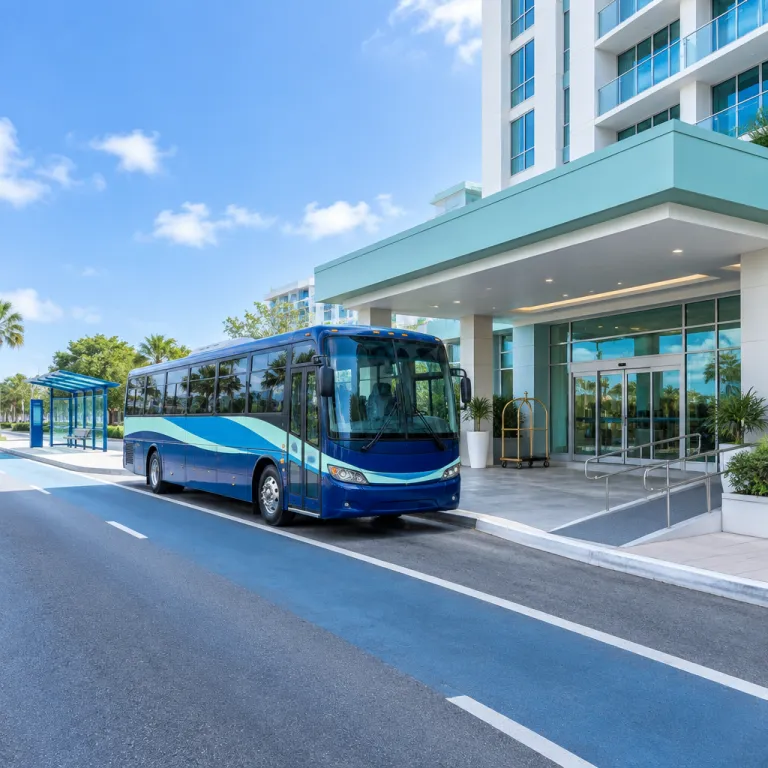
Designing Seamless Door-to-Door Bus Service for Airports, Rail, and Hotels
From terminal to lobby: rethinking seamless door to door bus service
For airlines, rail operators, and hoteliers, the real journey starts at the door. A modern door to door bus service can turn fragmented airport transfer and hotel shuttle segments into a single, curated ride that links airport, station, and hotel with one coherent promise. When every passenger feels that each trip is orchestrated around their time and comfort, loyalty quietly strengthens.
In this model, the bus is no longer a generic shuttle but a flexible transit asset that airlines and county transit authorities can jointly program. The bus will often operate in a defined service area that connects metro hubs, hotel clusters, and business districts, with scheduled departure windows rather than rigid timetables. This approach lets travel managers align transport services with flight waves, rail arrivals, and conference peaks, instead of forcing passengers to adapt to the bus service.
For the general public and corporate travellers, the value lies in predictability and clarity. Clear communication about service hours, the exact door service coverage, and how many hours advance are required for reservations reduces friction at every step. When a shared ride bus is positioned as an integral part of the travel product, not an afterthought, the perceived quality of the entire ride service improves. In practice, operators that publish precise pick up windows and guaranteed connection rules often see complaint rates about ground transport fall significantly within a year, as documented in internal quality reports from several European and North American airport shuttle providers between 2018 and 2022.
Designing shared ride networks that match airline and rail operations
Aligning a shared ride network with complex airline and rail schedules requires more than a timetable and a bus. Travel managers need a transportation blueprint that links each departure bank, each metro connection, and each hotel check in wave to a specific pattern of trips. The aim is to ensure that every passenger experiences the same reliable ride bus experience on weekdays as on weekends.
Operationally, this means defining a granular service area and mapping it to county transit corridors, airport terminals, and major rail stations. A well designed door to door bus service will use advance reservations to cluster passengers by neighbourhood, reducing deadhead time bus kilometres and improving on time performance. For airlines and rail companies, this clustering can be synchronised with their own departure control systems so that each bus will leave only when the right mix of passengers is confirmed.
Staffing models must also adapt to these patterns of demand. When planners use business days forecasts and real time data, they can set service hours that match actual arrival curves instead of legacy assumptions. Resources such as specialised airport transfer staffing frameworks, as outlined in this airport transfer staffing model for peak load management, help operators maintain quality even when the service offered is stretched by irregular operations. In one European hub, applying such a model allowed the operator to cover 90 percent of peak demand with planned staff while keeping on time performance above 92 percent, according to the operator’s 2021 service quality dashboard.
Integrating hotel shuttles, county transit, and metro into one coherent offer
Hotel groups and mobility platforms increasingly see that isolated shuttles are a dead end. A door to door bus service that connects smoothly with metro lines, county transit routes, and intercity rail creates a continuous transport chain from home door to hotel lobby. This chain lets passengers move through each area of the journey with minimal waiting time and fewer mode changes.
In practice, this integration means that a ride service must be planned as part of a multi modal ecosystem, not as a standalone bus. A hotel shuttle that feeds into county transit at a regional hub, then connects to a metro line, can still be marketed as a single shared ride experience if reservations and ticketing are unified. Case studies such as the Lowcountry corridor between Hilton Head Island and Savannah, analysed in this rethinking hotel shuttles and shared mobility article, show how coordinated services can replace fragmented, low occupancy buses.
For hoteliers, the benefit is a stronger promise at the moment of booking. When guests see that door services include guaranteed connections to metro and regional transport, they are more willing to choose advance reservations that lock in their trip pattern. Airlines and rail operators, in turn, can package these services as part of premium door service bundles that justify higher fares while still serving the general public fairly. In the Lowcountry example, consolidating several hotel shuttles into one shared ride network reportedly cut empty bus kilometres by more than 25 percent while maintaining average occupancies above 70 percent, based on 2019–2020 operating data shared by the regional mobility partnership.
Reservation systems, service hours, and the art of managing time
Time is the most sensitive currency in any airport to hotel trip. A well structured reservation system for door to door bus service transforms time from a source of anxiety into a managed asset for both passengers and operators. The key is to balance flexibility for the passenger with operational discipline for the transport provider.
Best practice is to require advance reservations while still allowing some same day bookings within defined service hours. For example, a ride bus network might accept bookings up to several days advance for groups, while individual passengers can reserve a shared ride up to two hours advance before departure. Clear rules about how many hours advance are needed for different services help travel managers plan itineraries and avoid last minute surprises at the door.
Digital interfaces must make these rules transparent. Instead of a confusing arrow slideshow of options, a simple left arrow and right arrow navigation with explicit time bus slots and service area maps gives clarity. When the system explains that the bus will operate on a fixed schedule on weekdays and on demand during weekends, the general public can quickly understand which service offered matches their travel needs. Operators that publish guaranteed pick up windows, such as “within 15 minutes of the booked time,” often report on time performance above 95 percent for shared ride operations, as reflected in annual punctuality statistics from large airport shuttle brands in London, Paris, and New York.
Service design for business days, monday friday peaks, and leisure flows
Demand for hotel related transport is never flat across the week. Business days from monday friday usually bring dense peaks around early morning departures and late afternoon arrivals, while leisure passengers tend to travel at more varied times. A resilient door to door bus service must therefore adapt its ride patterns and service hours to these distinct flows.
One effective approach is to run more frequent scheduled trips on business days, with fixed departure times aligned to airline and rail timetables. During these periods, the bus service can operate as a semi fixed route within the service area, allowing walk up passengers from the general public while still honouring advance reservations. On weekends and off peak periods, the same bus will often switch to a more flexible shared ride model, grouping passengers by area and optimising each trip for occupancy rather than strict timetable adherence.
For hoteliers and mobility platforms, this flexibility must be clearly communicated at the door and in all digital channels. Guests should know whether their ride service is a fixed time bus or a dynamically routed shared ride, and whether county transit or metro connections are guaranteed. When expectations are set precisely, even a longer transport time can feel acceptable because the service is perceived as honest and well managed. In internal surveys, several hotel chains have found that clear explanations of peak and off peak patterns can lift satisfaction with airport transfers by 10–15 percentage points.
Building a premium yet inclusive door to door bus service offer
Airlines, rail operators, and hotels increasingly want ground transport that feels premium but remains accessible to the general public. A carefully branded door to door bus service can achieve this by combining high quality vehicles, trained staff, and transparent pricing with inclusive service hours and broad service area coverage. The result is a ride service that supports both high yield corporate passengers and cost conscious leisure travellers.
Product design should start from the passenger perspective at the door, not from the bus depot. Clear information about the service offered, including whether the bus will operate as a shared ride or a near private ride bus, helps travel managers position the product correctly in corporate travel policies. Multi tier menus that combine shuttle, sedan, and ride hail options, as outlined in this guide to building a tiered airport transfer menu, show how different transport modes can coexist without confusing passengers.
Accessibility and equity must remain central. County transit partners can help ensure that door services reach underserved neighbourhoods, while hotels can guarantee that every passenger, not only loyalty members, can book trips within reasonable hours advance. When all actors align around a shared definition of quality, the humble bus becomes a strategic asset that quietly elevates the entire travel experience. As one airport ground transport manager put it in a 2022 industry roundtable, “when the bus ride feels as curated as the flight, passengers stop seeing it as a compromise and start seeing it as part of the premium journey.”
Key figures shaping door to door bus service and hotel transfers
- According to the International Air Transport Association, missed connections and onward ground transport issues contribute to a significant share of passenger complaints, which makes reliable door to door bus service a direct lever on satisfaction scores.
- Data from the American Public Transportation Association shows that coordinated airport and county transit services can increase public transport mode share for airport access by several percentage points, especially when integrated ticketing and clear service hours are offered.
- Studies from the Global Business Travel Association indicate that corporate travel managers increasingly favour suppliers that provide transparent advance reservations policies and guaranteed pick up time windows, which aligns closely with structured shared ride bus models.
- Urban mobility reports from major metro regions in Europe highlight that hotel shuttle consolidation into shared ride networks can reduce empty bus kilometres by double digit percentages, while maintaining or improving passenger satisfaction.
FAQ: door to door bus service for hotels and travel managers
How does door to door bus service differ from a traditional hotel shuttle ?
A door to door bus service collects and drops passengers at specific doors, such as home, office, or hotel, rather than only at fixed shuttle stops. It usually relies on advance reservations and defined service hours to group trips efficiently within a service area. This model offers more precise time management and better integration with airline and rail schedules.
What level of advance reservations is ideal for shared ride operations ?
Most operators find that requiring bookings several hours advance for individuals and a few days advance for groups balances flexibility with operational efficiency. This window allows planners to cluster passengers by area and optimise each trip without excessive waiting time. Travel managers should communicate these rules clearly in itineraries and booking tools.
How can hotels coordinate with county transit and metro systems ?
Hotels can sign partnership agreements with county transit agencies and metro operators to align service hours, stops, and information. Shared data on arrival patterns and passenger volumes helps all parties design better connections between the bus service and fixed route networks. Joint branding and unified wayfinding at terminals make these links visible to the general public.
Is door to door bus service suitable for both leisure and corporate travellers ?
Yes, when designed correctly, the same ride service can serve corporate and leisure segments. Business days may feature more frequent scheduled trips aligned with departure peaks, while off peak periods rely on flexible shared ride models. Transparent pricing and clear communication ensure that both segments understand what level of service is offered.
What are the main KPIs to track for hotel related bus services ?
Key indicators include on time performance relative to scheduled departure windows, average occupancy per trip, and the share of passengers using advance reservations. Customer satisfaction scores and complaint rates about ground transport also provide direct feedback on perceived quality. For integrated networks, monitoring transfers between bus, metro, and county transit helps identify weak links in the overall transport chain.