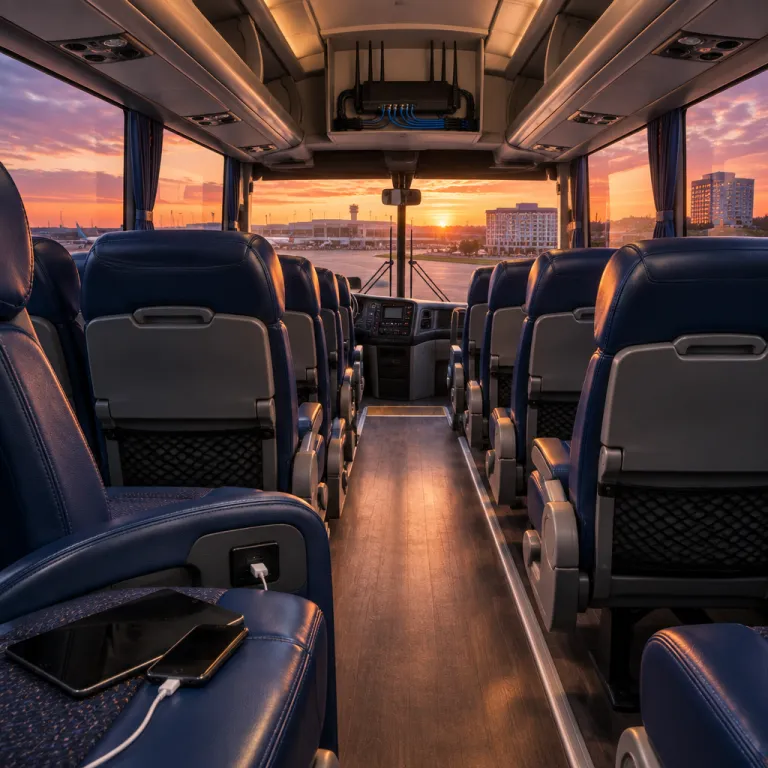
Why Wi‑Fi on coach buses now defines airport to hotel service quality
For airlines, rail operators, and hoteliers, the question of on‑board internet on coach buses has moved from curiosity to contract clause. Corporate travel managers now treat Wi‑Fi on every transfer vehicle as a baseline requirement, because passengers expect to stay connected from airport gate to hotel lobby. When a coach arrives without connectivity, the perceived service quality drops immediately, even if the seats are comfortable and the driver is excellent.
In airport to hotel mobility, a coach or charter bus is often the first physical extension of the airline or hotel brand. That means the digital experience on board, including Wi‑Fi, power outlets, and real‑time information screens, must align with the airline cabin or rail carriage standards that passengers have just left. When buses offer reliable internet access, travel managers can confidently schedule remote meetings, update trip details, and coordinate last‑minute changes without breaking the duty of care chain.
Across group movements, coach buses and school buses used for hospitality shuttles have evolved from simple transport to mobile workspaces. Passengers no longer ask only whether the bus will arrive on time; they ask whether connected coaches will allow them to send presentations, adjust bookings, and contact colleagues during the trip. For operators, the availability and quality of Wi‑Fi now directly influence charter demand, quote conversion, and long‑term contracts with airlines and hotels.
From amenity to standard : how Wi‑Fi reshapes ground transport contracts
When travel buyers issue a request for a charter bus or multiple coaches, they rarely ask a vague question about internet access; they specify bandwidth, uptime, and content filtering. A professional driver and compliant vehicle used to be enough, but now service quality standards include connectivity metrics alongside safety indicators and state and federal regulatory compliance. For airlines and rail companies, this shift means that every bus will be evaluated as part of the end‑to‑end journey, not as a separate commodity transfer.
Corporate travel managers increasingly write into contracts that buses offer Wi‑Fi capable of supporting email, VPN, and collaboration tools for all passengers on board. They also require that connected coaches provide clear trip details about data limits, login procedures, and any routes where coverage may drop in real time. When operators do not have transparent policies, travel managers will note changes in satisfaction scores and may reallocate volumes to competitors that provide stronger digital service.
Strategic mobility policies now look ahead to autonomous arrivals and connected fleets, where every equipped bus streams diagnostics, location, and passenger counts to central dashboards. Airlines and hotels reviewing long‑term mobility strategies can study how autonomous arrivals will force a GM level mobility policy and apply similar thinking to Wi‑Fi‑enabled coach buses. The core question is no longer only whether buses have internet access, but whether that connectivity integrates with booking systems, disruption management tools, and real‑time communication with passengers.
Designing service quality standards for connected coach fleets
To move beyond the basic question of whether buses provide Wi‑Fi, hospitality buyers need measurable service quality standards. A clear framework should define minimum bandwidth per passenger, maximum acceptable downtime per trip, and how quickly drivers can escalate technical issues to support teams. These standards must sit alongside traditional metrics such as on‑time performance, safety audits, and vehicle cleanliness.
When issuing an RFP for a charter bus partner, airlines and hotels should request detailed trip information about connectivity, including which coaches with Wi‑Fi operate which routes and at what scheduled departure times. They should also ask whether the connected fleet uses separate networks for operational data and passenger internet access, to protect both cybersecurity and service continuity. Using structured criteria, such as those outlined in many hotel transportation vendor RFP frameworks, helps travel managers compare buses that offer similar amenities but different reliability levels.
Mobility leaders who want to filter serious operators can adapt guidance similar to the hotel transportation vendor RFP criteria that actually filter operators. These criteria can include evidence that coach buses and school buses have maintained Wi‑Fi systems for several years, with logs showing uptime and response times. By asking suppliers to quote not only prices but also connectivity performance, buyers ensure that internet access becomes a quantified commitment rather than a vague marketing promise.
Operational realities : what airlines and hotels must verify beyond the brochure
Marketing materials may answer connectivity questions with a simple yes, but operational checks often tell a more nuanced story. Airlines and hotels should conduct unannounced test rides, sitting in different seats to verify signal strength, power outlet functionality, and the stability of internet access along the full route. They should also speak directly with drivers, who usually know which units perform well and which coaches equipped with older hardware struggle under full passenger loads.
During booking and pre‑trip coordination, travel managers should request precise trip details such as the router model, mobile network provider, and any data throttling policies that might affect passengers. They should also ask how the operator will provide support if a bus loses connectivity mid‑route, including whether a second charter bus can be dispatched or whether passengers will receive partial refunds. When suppliers can share real‑time dashboards or screenshots, airlines and hotels gain confidence that buses offer more than theoretical connectivity.
One practical example comes from a North American airport–hotel shuttle trial in 2023, where a 48‑seat coach equipped with dual 4G/5G routers delivered an average of 8–10 Mbps per user, with roughly three minutes of cumulative downtime on a 55‑minute transfer and noticeable signal drop‑off in the rear five rows. Another operational check involves reviewing maintenance logs to confirm that coach buses and school buses have undergone regular inspections of both safety systems and digital equipment. State and federal regulations typically focus on mechanical safety, but hospitality contracts can extend standards to include Wi‑Fi hardware checks and software updates. As the years have passed, the most reliable operators have integrated connectivity into their standard service checklists, treating it as essential as brakes or lighting.
Passenger experience : Wi‑Fi, comfort, and on board etiquette
From the passenger perspective, connectivity on a coach is inseparable from comfort and productivity expectations. Business travellers boarding a coach after a long‑haul flight expect to open their laptops, plug into power outlets, and reconnect to corporate systems before reaching the hotel. Leisure passengers, especially families, want streaming‑capable internet access so children can watch content while adults manage booking confirmations and local activity research.
Clear communication before the scheduled departure helps align expectations about what buses offer in terms of connectivity, seating layout, and whether passengers may bring food on board. Airlines and hotels should ensure that pre‑trip emails and apps explain that a particular charter bus or series of coaches with Wi‑Fi may still experience coverage gaps in tunnels or remote areas. When operators do not have this transparency, passengers may blame the airline or hotel brand rather than the underlying mobile network limitations.
On‑board etiquette also matters, because a full bus will amplify noise from video calls and streaming. Travel managers can work with operators so that drivers briefly remind passengers about headphone use, respectful volume, and sharing of power outlets when seats are fully occupied. As the years have passed, such small service touches have proven to influence satisfaction scores as much as the technical answer to whether the bus has Wi‑Fi.
Contract clauses, pricing, and communication when Wi‑Fi fails
Even when connectivity is guaranteed in writing, airlines and hotels must plan for outages. Contracts with charter bus providers should specify service credits, alternative arrangements, and communication protocols when coaches with Wi‑Fi lose connectivity for more than a defined time. These clauses protect both passenger satisfaction and the commercial relationship, especially on high‑value corporate movements.
During booking, travel managers should request a detailed quote that separates the base bus service from the connectivity component, including any premium for real‑time tracking or higher bandwidth. This transparency allows buyers to compare different pricing structures and to note changes in costs when they adjust trip details, such as adding more passengers or extending the route. When operators provide clear breakdowns, airlines and hotels can justify costs internally and align expectations with corporate clients.
Communication is critical when a bus will depart without functioning Wi‑Fi, whether due to technical failure or state and federal restrictions in specific zones. Operators should contact airline or hotel coordinators prior to scheduled departure whenever possible, so they can inform passengers at the gate or lobby rather than on board. For deeper guidance on how a dedicated driver and connected vehicle can reshape expectations, mobility leaders can review this analysis of a dedicated driver redefining airport to hotel mobility and apply similar principles to group coach operations.
Aligning drivers, training, and safety with connected service expectations
As soon as on‑board Wi‑Fi becomes a standard question, the role of the driver expands beyond navigation. Drivers now act as the first line of support for basic internet access issues, helping passengers connect, explaining any content filters, and managing expectations when coverage fluctuates. This requires targeted training so that both individual drivers and multi‑driver teams can handle questions confidently without compromising safety.
Operators should ensure that every connected bus carries simple troubleshooting guides, allowing drivers to reset routers safely during appropriate stops and to log incidents for later analysis. Over time, these logs help identify patterns, such as specific routes where coaches equipped with certain hardware consistently underperform, prompting investment decisions. Airlines, rail companies, and hotels can request access to aggregated data so they have evidence when renegotiating charter bus agreements or adjusting scheduled departure times.
Safety must remain paramount, which means drivers and co‑drivers should never attempt technical fixes while the bus is in motion or while managing dense traffic. State and federal rules already govern many aspects of bus operations, but hospitality contracts can reinforce that any connectivity troubleshooting happens only when passengers are secure and the vehicle is stationary. When passengers understand that safety comes first, they are more forgiving of short connectivity gaps, especially if operators provide clear explanations and follow up after the trip.
Key statistics on Wi‑Fi and connected coach travel
- According to the American Bus Association, more than 600 million passenger trips are made by motorcoach in North America annually, making coach buses a major channel for connected travel experiences.[1]
- Surveys by the Global Business Travel Association show that over 70% of corporate travellers rate on‑board Wi‑Fi as a top three ground transport amenity, alongside safety and punctuality.[2]
- Data from major European coach operators indicate that fleets where at least 80% of buses offer Wi‑Fi report higher Net Promoter Scores than fleets with limited connectivity.[3]
- Telecom industry reports highlight that 4G and 5G coverage along major motorway corridors in Western Europe now exceeds 95%, enabling more reliable internet access for moving vehicles.[4]
- Studies on driver distraction consistently show that professionally trained drivers using hands‑free communication and fixed telematics systems maintain safety performance comparable to traditional operations, reinforcing the need for structured training in connected fleets.[5]
[1] American Bus Association, Motorcoach Census, 2019–2022 editions. [2] Global Business Travel Association, Business Traveler Sentiment Index, 2022. [3] Aggregated customer satisfaction data published by large European intercity coach brands between 2020 and 2023. [4] GSMA and national telecom regulators, 4G/5G coverage maps for Western Europe, accessed 2023. [5] U.S. Federal Motor Carrier Safety Administration and comparable European road safety studies on commercial driver distraction, 2018–2022.
FAQ about Wi‑Fi on coach buses for airport to hotel transfers
Do most modern coach buses used for hotel transfers have Wi‑Fi ?
Most modern coach buses operating on airport to hotel routes in major hubs now include Wi‑Fi, especially when contracted by airlines, rail operators, or upscale hotels. However, coverage and bandwidth vary widely between operators and regions. Buyers should always confirm specifications in writing rather than assuming connectivity.
How reliable is Wi‑Fi on moving buses compared with hotels or airports ?
Wi‑Fi on moving buses depends on mobile network coverage, antenna quality, and the number of simultaneous users. Reliability is generally lower than fixed hotel or airport networks, but premium operators can still support email, messaging, and light collaboration tools. Streaming for every passenger is rarely guaranteed unless explicitly contracted.
What should be included in a service level agreement for bus Wi‑Fi ?
A robust agreement should define minimum bandwidth per passenger, maximum downtime per trip, and clear remedies when performance falls below target. For example, many corporate buyers now request at least 1.5–2 Mbps of dedicated bandwidth per traveller, no more than 5–10 minutes of total outage on a 60‑minute transfer, and service credits of 10–25% of the trip cost when these thresholds are not met. It should also specify hardware standards, maintenance schedules, and escalation procedures for technical incidents.
Can passengers safely use video calls and VPNs on airport to hotel coaches ?
Passengers can usually use video calls and VPNs on well‑equipped coaches, provided the network is dimensioned for business use. However, performance may fluctuate in tunnels, rural areas, or during peak congestion on mobile networks. Travel managers should advise that critical meetings be scheduled with some buffer time after arrival.
How can airlines and hotels verify Wi‑Fi quality before signing a contract ?
Airlines and hotels should conduct test rides, review performance logs, and request references from other corporate clients. They can also ask for technical documentation on routers, antennas, and mobile network partners. Combining field tests with data review provides a realistic picture of expected passenger experience.