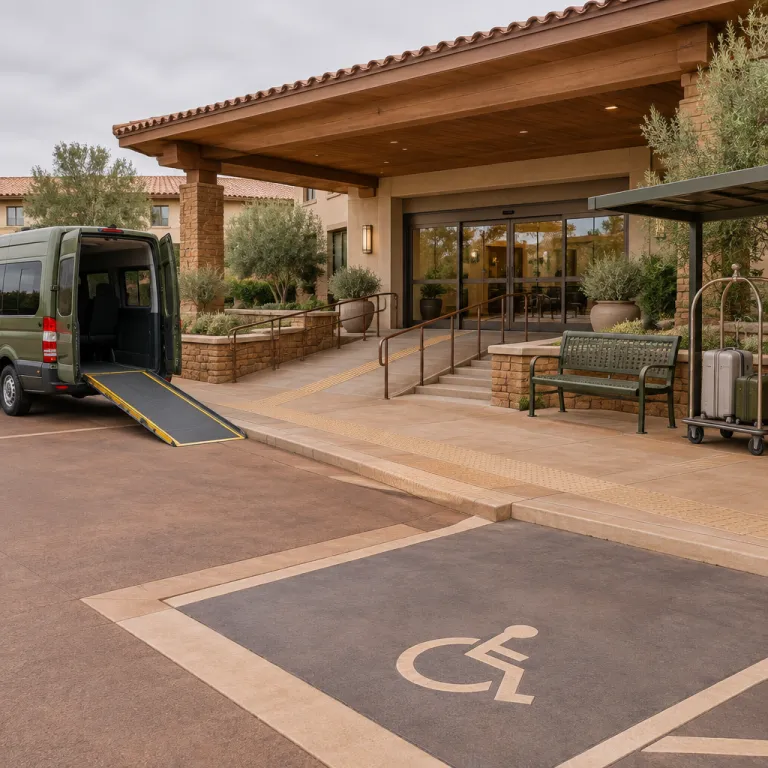
The curbside gap: when ADA stops at the lobby door
Most hotels consider themselves accessible once the ramp, elevator and room are compliant. Yet the accessible hotel transportation piece between the airport curb and the hotel driveway often remains a blind spot where guests with disabilities quietly absorb the friction. For a general manager, that gap between polished lobby accessibility and messy ground transportation is where loyalty is either cemented or lost.
In the United States, ADA compliance for public spaces is now a baseline, but ADA obligations for transportation services linked to hotels are less consistently understood. When a property advertises an airport shuttle or partners with shuttles, taxis or ride hail, it steps into the domain of accessible transportation and must provide equivalent service for wheelchair users and guests with disabilities. If a standard shuttle service runs every 20 minutes while the wheelchair accessible vehicle appears only “on request” with a 90 minute delay, that is not an equivalent service and it fails both duty of care and commercial logic.
Accessible hotel transportation starts with a clear map of every touchpoint where a guest moves between airport, station, public transit node and hotel. That map should include airport shuttle pick up zones, taxi queues, hotel shuttles, valet handoffs, partner limousine services and any accessible shuttle or accessible taxi options promoted on the website. For each touchpoint, the GM should ask whether people with disabilities receive the same level of service, the same waiting time and the same information as other guests, and whether the physical accessibility of vehicles, sidewalks and entrances matches the promise made in marketing.
What wheelchair accessible coverage really means for fleets and partners
For airlines, rail operators and hotels, the phrase wheelchair accessible vehicle often hides a fragile reality. One lift equipped van shared across several properties or an informal list of accessible taxi numbers does not constitute robust coverage for accessible travel. To serve wheelchair users with dignity, accessible hotel transportation must be engineered with the same rigor as revenue management or housekeeping staffing.
True coverage starts with the fleet mix across all ground transportation partners serving the airport hotel corridor. A GM should know exactly how many wheelchair accessible vehicles are available at peak times, how many are lift equipped versus simple ramp conversions, and which services can provide equivalent response times to standard sedans. On demand ride hail rarely guarantees a wheelchair accessible car at short notice, so contracts with specialized transportation services and airport shuttle operators remain essential for predictable accessibility. For a deeper view on how van and driver rental models can support this, many operators now study seamless airport transfer ecosystems for high value guests and then extend those principles to guests with disabilities.
Advance booking windows are another hard constraint that mobility professionals must respect. If accessible airport transfers require 24 hours notice while standard shuttles accept walk ups, the hotel must either increase accessible shuttle capacity or clearly communicate the limits before guests travel. Airlines, rail companies and transfer platforms can help by integrating accessible transportation options into booking flows, allowing guests to request an airport shuttle or accessible taxi at the same time as their flight or train, so that hotels can provide equivalent planning and avoid last minute improvisation.
Contracting for accessibility: SLAs, not best effort promises
Most airport hotel transfer contracts still treat accessibility as a clause, not a performance metric. For accessible hotel transportation to work for every guest, GMs and travel managers need accessibility service level agreements that sit alongside on time performance and cost per trip. That means writing wheelchair accessible capacity, response times and training requirements directly into ground transportation contracts with shuttle, taxi and van providers.
At a minimum, contracts should specify that transportation services must provide equivalent service for guests with disabilities, including comparable wait times, booking channels and hours of operation. If a provider operates hotel shuttles, the agreement should state how many vehicles are lift equipped, how often those accessible shuttles circulate, and what contingency exists when one accessible airport vehicle is out of service. For airport shuttle and airport taxi partners, clauses should also address ADA compliance, driver training on assisting wheelchair users safely, and clear escalation paths when accessible transportation fails.
Digital coordination matters as much as legal language. Hotels that integrate flight aware tools into their airport shuttle service, as explored in analyses of how flight aware services reduce wait times, can extend the same data to accessible shuttle operations so that guests with disabilities are not left waiting after delays. Transfer platforms and mobility providers should share real time data on accessible taxi and shuttle availability, allowing hotel teams to provide equivalent updates to all guests, whether they use public transit, private ground transportation or wheelchair accessible vans.
Designing the arrival: staff, communication and ageing luxury travellers
The most accessible fleet in the world still fails if the arrival moment is clumsy. Accessible hotel transportation is ultimately judged in the ten metres between the vehicle door and the hotel threshold, where luggage, communication and dignity intersect. For ageing luxury travellers and guests with sensory or cognitive needs, that short distance often defines their perception of the entire stay.
Front office and bell teams should be trained to meet an accessible shuttle or accessible taxi with the same choreography they apply to VIP limousines. That means knowing how to operate lift equipped vehicles safely, how to position portable ramps when public sidewalks create gaps, and how to speak directly and calmly with guests with disabilities rather than only addressing accompanying family members. Clear, simple language about timing, routes and any use of public transit or airport hotel connections helps reduce anxiety for guests who may already have navigated complex airport or station environments.
The ageing traveller segment is growing, and many of these guests do not self identify as people with disabilities yet still value accessible transportation options. For them, a guaranteed airport shuttle with minimal steps, grab handles and patient drivers can be the difference between choosing one hotel or another. As one industry expert has put it, "Every missed wheelchair ramp or delayed accessible shuttle is not just a service failure ; it is a broken promise to a guest who trusted your brand with their mobility." When accessible travel is framed as a retention lever rather than a cost centre, investments in training, communication and vehicle upgrades start to look like long term loyalty insurance.
An audit the GM can run this quarter across every transport touchpoint
To move from intent to execution, GMs need a practical audit of accessible hotel transportation that fits into a single quarter. Start at the website and booking flows, checking whether accessible transportation options, wheelchair accessible vehicles and airport shuttle details are clearly described in plain language. Then follow the guest journey step by step, from airport or station arrival through every transfer, asking whether people with disabilities receive truly equivalent service.
At the airport, verify signage and wayfinding from baggage claim to the accessible airport shuttle stop, taxi rank or public transit station. Confirm that at least some airport hotel shuttles are lift equipped, that drivers know how to secure wheelchairs, and that dispatchers can provide equivalent wait time estimates for wheelchair users and other guests. If the property relies on public transit or third party ground transportation, document how guests with disabilities are informed about accessible routes, accessible taxi booking numbers and any limitations in local accessible transportation services.
Back at the hotel, inspect the driveway, curb cuts and paths between shuttle drop off points, taxi stands and the lobby entrance. Check whether staff can explain accessible travel options confidently, whether they know how to book an accessible taxi or accessible shuttle, and whether internal SOPs reference ADA compliance and equivalent service obligations. Finally, review contracts with all transportation services, using resources on how van and driver rental is redefining hotel ground transportation as a benchmark, and then set measurable KPIs for accessible hotel transportation such as average wait time for wheelchair users, percentage of lift equipped vehicles in rotation and guest satisfaction scores from travellers with disabilities.
Aligning airlines, rail, mobility platforms and hotels around the accessible arrival
Accessible hotel transportation does not sit solely on the shoulders of a single property. Airlines, rail companies, mobility platforms and transfer services all shape the experience between the airport gate, the station platform and the hotel lobby. When these actors align around accessibility, the result is a coherent corridor of care rather than a patchwork of isolated efforts.
Airlines and rail operators can embed accessible travel questions into booking flows, allowing guests to request wheelchair assistance, accessible transportation and specific shuttle service needs in one place. That data, shared securely with hotels and ground transportation partners, helps them provide equivalent service without last minute scrambling at the airport curb. Mobility platforms and transfer aggregators can label wheelchair accessible options clearly, show which vehicles are lift equipped, and surface public transit alternatives that are genuinely accessible rather than theoretically step free.
For hotel groups and airport hotel clusters, joint procurement of accessible shuttle fleets and shared training programmes can raise the accessibility baseline across an entire destination. Public authorities responsible for airports, stations and public transit nodes should be engaged as partners, ensuring that curbside design, signage and enforcement support accessible taxi operations and hotel shuttles rather than hindering them. When every stakeholder treats accessible transportation as both a legal obligation and a commercial opportunity in an ageing market, the accessible arrival stops being a niche topic and becomes a core pillar of competitive hospitality.
FAQ
What does equivalent service mean for accessible hotel transportation ?
Equivalent service means that guests with disabilities receive transportation options with similar wait times, booking methods, hours of operation and comfort levels as other guests. If a standard airport shuttle runs every 20 minutes, a wheelchair accessible shuttle should operate on a comparable schedule. Longer delays or complex booking processes for accessible vehicles generally do not meet the spirit of ADA requirements.
Are hotels legally required to provide wheelchair accessible shuttles ?
In the United States, hotels that offer transportation services such as airport shuttles are subject to ADA transportation rules, which require them to provide accessible vehicles or ensure equivalent service through partners. Properties that advertise shuttle service but cannot accommodate wheelchair users risk non compliance and guest complaints. Legal obligations can vary by jurisdiction, so hotel groups should review federal, state and local regulations with counsel.
How can a GM quickly assess the accessibility of current transport partners ?
A GM can start with a simple checklist covering fleet composition, response times and training. Key questions include how many lift equipped vehicles are available, how long a wheelchair user waits compared with other guests, and whether drivers are trained to assist people with disabilities safely. Reviewing contracts for explicit accessibility clauses and testing the booking process as a mystery guest with mobility needs will reveal most gaps.
Why is accessible ground transportation a commercial opportunity, not just a cost ?
Ageing travellers, guests with chronic conditions and families with mobility needs represent a growing share of high value hospitality demand. When a hotel or airport hotel consistently provides reliable accessible transportation, these guests are more likely to return and to recommend the property. Over time, that repeat business and positive word of mouth can outweigh the incremental costs of accessible vehicles and training.
How should airlines and rail operators coordinate with hotels on accessibility ?
Airlines and rail operators can collect accessibility needs during booking and share them, with consent, with hotel and transfer partners. This allows airport shuttle operators, accessible taxi providers and hotels to plan lift equipped vehicles and staff support in advance. Joint protocols for delays, missed connections and rebooking help ensure that guests with disabilities are not stranded when travel plans change.