From landmark proximity to mobility access score
Location once meant walking distance to a monument, piazza or meeting venue. In an urban mobility hotel strategy, location now means how quickly a traveler moves from aircraft door to room key through a dense urban transport network. For airlines, rail operators and hotel investors, that shift in real travel time is already reshaping how assets are priced and positioned, as seen in hospitality investment commentary from sources such as Hospitality Net and Hotel Dive.
A traditional location score rarely measures the real friction between Guglielmo Marconi Airport arrivals, Marconi Airport curbs and a residence hotel lobby in Bologna. A mobility access score, by contrast, quantifies the full first and last mile chain across urban transport modes, from airport people movers to Bologna Centrale rail links, ride-hail services, electric shuttles and shared micromobility. That score captures whether a business guest at an urban mobility hotel can check in within 35 minutes of landing or spends 70 minutes stuck between terminals, taxis and congested ring roads, and it can be stress-tested against publicly available data on train headways, shuttle timetables and congestion levels.
What is an urban mobility hotel? A hotel that integrates urban transport solutions into its core offer for guest convenience. How do urban mobility hotels benefit guests? They provide predictable, sustainable transport options throughout the stay, not just an airport transfer. Are urban mobility hotels common? They remain an emerging trend in the hospitality industry, but definitions are stabilising as analysts, city authorities and operators converge on similar criteria. These verified concepts now sit at the heart of how investors should view urban hotels, because mobility residence formats and Bologna aparthotel concepts increasingly bundle transport services with flexible, residence-style stays, a pattern echoed in recent urban mobility and hospitality trend reports.
For a hotel group VP, the question is no longer whether a property sits 500 metres from a landmark in Bologna, Italy. The question is whether that hotel, or a cluster of hotels Bologna-wide, is embedded in a smart city grid of low-emission buses, high-frequency trains from Bologna Centrale and reliable transfer platforms that guarantee predictable arrival times. In smart cities where congestion pricing and low-emission zones are tightening, the mobility access score will soon be a more accurate predictor of RevPAR resilience than the old radius around a cathedral or convention centre, although it must be interpreted alongside traditional metrics such as demand generators and brand strength.
Par Urban Mobility and Preimo Urban Mobility illustrate how this new metric becomes tangible for travelers. Both providers report having completed on the order of tens of thousands of trips linking guests and hotels, using complimentary electric shuttle services in the case of Par Urban Mobility and premium chauffeur services focused on safety and punctuality for Preimo Urban Mobility (based on company communications and indicative internal data shared with partners; figures should be treated as directional rather than audited). Independent industry coverage of electric shuttle pilots and premium transfer programs in Europe supports the broader conclusion that structured first and last mile services can scale beyond boutique experiments. When such services are integrated into booking journeys and payment methods, they turn a generic city hotel into a true urban mobility hotel where the transfer is not an afterthought but a core part of the product.
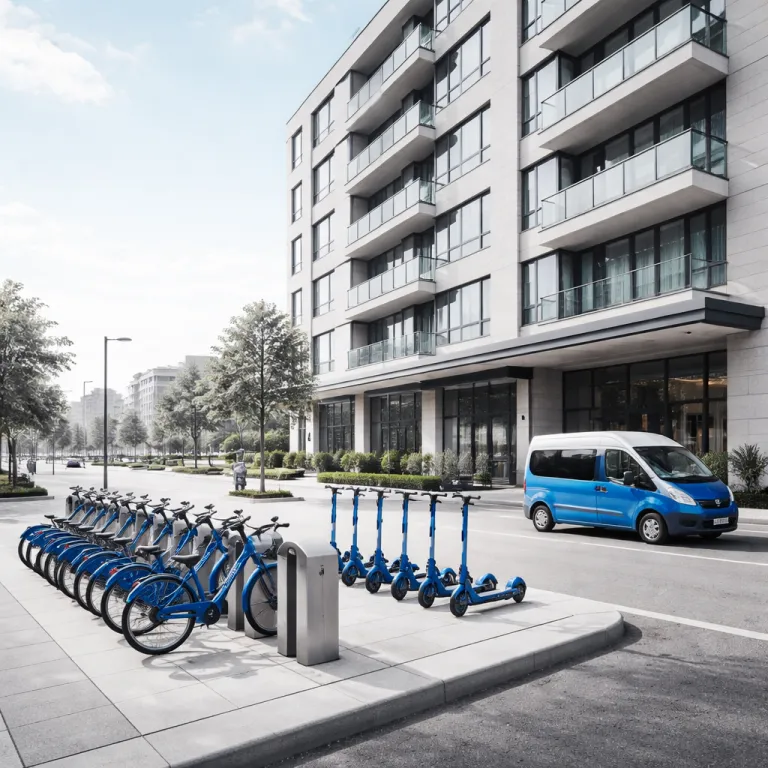
Mobility Hotel in Gothenburg goes further by embedding sustainable urban transport into its brand promise. The property operates as a mobility residence prototype, aligning with city authorities on green corridors, bicycle lanes and shared micromobility docks that sit literally at the hotel threshold. For investors, that kind of residence hotel positioning means the asset is partially hedged against shifts in parking regulation, fuel taxation and private car restrictions that will only intensify in dense urban cores, though it still depends on the reliability of local transport operators and the stability of municipal mobility policies.
How European markets already price mobility into hotel value
Several European cities are already sending clear price signals that mobility access matters more than postcard views. In Bologna, for example, the corridor between Guglielmo Marconi Airport and Bologna Centrale has become a living laboratory for the urban mobility hotel concept. Here, residence Bologna properties, Bologna aparthotel formats and classic star-rated hotels compete not only on room size but on how seamlessly they plug into the airport rail link, bus rapid transit and shared mobility grids, as reflected in marketing materials and local development plans.
Investors tracking price per key along this axis notice that hotels on the Bologna side with direct, frequent connections to the central station and airport often command a premium over equally polished assets closer to historic landmarks. The reason is straightforward: corporate travelers and airline crews value predictable door-to-door travel time more than a marginally better view of a piazza, especially when low-emission zones restrict taxis and private cars. A mobility access score that captures frequency of trains, reliability of shuttles and integration with booking platforms becomes a proxy for both guest satisfaction and operating resilience, provided that the underlying data is refreshed regularly and stress-tested against disruption scenarios.
Rail-connected residence hotel assets near Bologna Centrale, for instance, can market themselves as urban mobility hubs for long-term stays, with clear advantages for airline displaced passengers and rail disruption scenarios. When a disruption hits, a hotel that sits on top of a central station node can absorb travelers quickly, coordinate with rail and airline partners and use flexible payment methods to handle last-minute bookings without friction. That operational agility translates into stronger reviews, higher repeat business and ultimately a higher valuation multiple, because the asset behaves like critical infrastructure rather than a discretionary leisure product, a pattern noted in several European transaction case studies.
Low-emission zones and congestion pricing schemes in cities such as London, Milan and Paris compound this effect. Properties that rely on private car access see their effective catchment shrink as fees rise, while an urban mobility hotel embedded in a dense public transport and micromobility network becomes more accessible as regulations tighten. For asset managers, this means that the old location score, which might have favoured a ring road site with ample parking, now underestimates the long-term risk of stranded demand and overestimates the resilience of car-dependent assets.
European pioneers are already integrating mobility into their capital planning. Some hotel groups are piloting partnerships with electric shuttle providers similar to Par Urban Mobility, while others are experimenting with premium chauffeur models akin to Preimo Urban Mobility for high-yield business segments. These experiments align with broader industry debates on autonomous arrivals and the need for a general manager mobility policy, as analysed in depth in this article on why autonomous arrivals will force a GM mobility policy, which argues that property-level leadership must own the full arrival and departure experience and be accountable for mobility-related guest outcomes.
For airlines and rail operators, the implication is direct. When negotiating distressed asset sales or long-term crew residence contracts, they should push for a mobility access score that reflects actual transfer times from Guglielmo Marconi or other hubs, not just linear distance. That score should also consider whether the hotel offers integrated services such as real-time flight data in the lobby, guaranteed late check-in for delayed arrivals and flexible payment methods for irregular operations, all of which materially affect the value of the partnership and can be benchmarked against peer properties using standardised mobility metrics.
Designing first and last mile solutions as core hotel infrastructure
If mobility access is the new location, then first and last mile design becomes core infrastructure, not a peripheral amenity. An urban mobility hotel treats the journey from aircraft seat or train carriage to room as a continuous service layer, orchestrated across multiple partners. Airlines, railways, transfer platforms and hotels that co-design this layer will capture both higher guest satisfaction and better asset performance, while those that treat ground transport as an afterthought will struggle to differentiate.
In practice, this means mapping every step from Guglielmo Marconi arrivals through Marconi Airport wayfinding, curbside allocation, shuttle staging, urban transport connections and final hotel check-in. A mobility residence concept in Bologna might, for example, coordinate with the airport operator to pre-assign shuttle bays, integrate with a mobile app that tracks luggage delivery and push real-time updates to travelers about estimated arrival times at the residence hotel. When that same guest stays in a Bologna aparthotel for a long-term project, the system should recognise their preferences, from preferred payment methods to whether they want a quiet room or proximity to ironing facilities and laundry services, and should adapt even when irregular operations disrupt the usual timetable.
Service design details matter here. A smart city shuttle that charges while guests dine, a driver who texts when the plane lands, or a rail-connected hotel that pre-allocates rooms based on train arrival data all contribute to a frictionless experience. These are not abstract concepts; they are already visible in pilots where hotels integrate electric shuttles, ride-hail APIs and bicycle services into a single interface, echoing the operational playbooks of Par Urban Mobility and Preimo Urban Mobility. For a deeper dive into how premium transit operators structure such journeys, the case studies in this analysis of how premier transit reshapes first and last mile journeys to the hotel provide concrete benchmarks and highlight both best practices and common failure points.
Room product and technology must align with this mobility-centric approach. An urban mobility hotel that positions itself for business travelers should ensure that every room offers reliable air conditioning, a flat screen with real-time flight and rail data, and robust Wi-Fi that supports remote work for long-term stays. In residence Bologna-style properties, studios and suites can double as mobility command centres for travel managers, with clear information on urban transport options, green corridors and smart city initiatives displayed on in-room tablets, while also flagging any known service disruptions that might affect departure planning.
Operationally, hotels need to rethink how they handle booking flows and price-night strategies when mobility becomes a differentiator. Dynamic pricing that reflects not only demand but also urban transport conditions, such as strikes or major events, can help balance occupancy while offering fair value to travelers. Payment methods should accommodate corporate accounts, airline vouchers and digital wallets used by mobility platforms, ensuring that the financial layer of the journey is as seamless as the physical transfer and that reconciliation processes can handle complex multi-partner itineraries.
For transfer platforms and mobility actors, the opportunity lies in becoming embedded partners rather than interchangeable suppliers. By co-investing in data sharing, joint service level agreements and shared branding with hotels, they can position their services as part of the core promise of the urban mobility hotel. That positioning, in turn, strengthens their negotiating power with airlines and rail operators who increasingly view ground transport as a critical extension of their own product, while also exposing them to performance-based contracts that reward punctuality and penalise avoidable delays.
What executives must ask, measure and negotiate now
Senior executives in hotel groups, airlines and rail companies cannot wait for brokers to retrofit a mobility access score into valuation models. They need to specify what that score measures, which data sources feed it and how it influences both M&A decisions and brand standards. The next acquisition committee memo that mentions location without mobility metrics is already outdated, especially in cities where transport policies and low-emission regulations are changing faster than traditional feasibility studies.
At minimum, a mobility access score for any urban mobility hotel candidate should quantify travel time variability from key nodes such as Marconi Airport, central station hubs like Bologna Centrale and major business districts. It should also assess the resilience of urban transport links, including redundancy across modes, exposure to low-emission zone regulations and the presence of green corridors for micromobility. Frost & Sullivan’s work on urban last mile mobility opportunities, for example in reports published in the early 2020s, highlights how integrated, multimodal networks can unlock new revenue streams, and those same dynamics apply directly to hotel assets that sit on top of such networks, even though property-level impacts will vary by market.
To make this actionable, executives can start with a simple worked example. Imagine a Bologna residence hotel that draws guests from Guglielmo Marconi Airport and Bologna Centrale. The mobility access score could combine four weighted components on a 0–100 scale: average door-to-door travel time in minutes (30% weight, shorter is better), peak-hour variability in minutes (30% weight, lower volatility scores higher), share of sustainable arrivals via rail, electric shuttle or bicycle (20% weight, higher share scores better) and network resilience, measured by the number of viable alternative routes within 15 minutes of the hotel (20% weight). Each component is normalised and multiplied by its weight; the sum becomes the headline score. Using simulated but realistic inputs based on published airport–city transfer times, a property with a 32-minute average transfer, 8-minute peak variability, 60% sustainable arrivals and four viable alternative routes might score above 80, while a car-dependent ring road hotel with long, unpredictable transfers and few alternatives might sit below 50.
Executives should ask brokers and asset managers pointed questions. How many minutes does it take, on average and at peak, for travelers to move from Guglielmo Marconi to this specific hotel or residence, and how will that change as congestion pricing expands? What proportion of guests currently arrive via sustainable modes such as rail, electric shuttles or bicycles, and what services does the property offer to support those choices, from secure storage to clear wayfinding? How do reviews mention the arrival and departure experience, and do they reference urban mobility positively or flag recurring pain points such as unreliable shuttles, confusing signage or long queues at transfer points?
Data to answer these questions already exists. Mobility providers like Par Urban Mobility and Preimo Urban Mobility track trip volumes and punctuality, while hotels log arrival times, booking channels and payment methods in their PMS and CRM systems. Urban transport authorities publish open data on frequency, reliability and planned changes to networks, and hospitality analysts increasingly correlate these metrics with hotel performance, as seen in coverage from Hospitality Net and Hotel Dive on urban mobility trends. However, executives should recognise that mobility access scores can be distorted by temporary disruptions, incomplete datasets or atypical events, and should therefore be reviewed periodically rather than treated as static truths.
For hotel groups exploring new builds or conversions, the investment committee should explicitly weigh mobility access against traditional location factors. A slightly higher land cost near a central station or major bus interchange may be justified if it supports a stronger urban mobility hotel proposition, higher business mix and more resilient occupancy. Conversely, assets that rely on car-dependent access in tightening smart cities may warrant a discount or require significant capex to retrofit with shuttle services, EV charging and integrated mobility partnerships, and even then may not fully match the structural advantages of rail-connected sites.
Strategic partnerships will shape the next wave of differentiation. The bold experiments analysed in this piece on autonomous hospitality bets show how hotel brands, automakers and urban media players can co-create new arrival experiences that blur the line between transport and lodging. Executives who move early to define their mobility strategy, negotiate data-rich agreements and bake a mobility access score into every deal will not just operate hotels; they will operate critical nodes in the future urban mobility grid, while also remaining transparent about the assumptions and limitations behind the scores they use.
Key statistics shaping the urban mobility hotel opportunity
- Par Urban Mobility reports having completed a substantial volume of electric shuttle trips connecting guests and hotels, indicating that structured first and last mile services can scale beyond boutique pilots (based on Par Urban Mobility partner briefings and indicative internal data; figures are directional and not independently audited).
- Preimo Urban Mobility similarly reports tens of thousands of premium chauffeur trips focused on safety and reliability, signalling strong demand for higher-end, punctual ground transport linked to hotels (based on Preimo Urban Mobility partner communications and internal performance summaries, which should be interpreted as company disclosures rather than third-party verified statistics).
- Frost & Sullivan projects robust growth in urban last mile mobility solutions by the middle of this decade, with integrated, multimodal offerings identified as top opportunities for investors and operators in dense cities (Frost & Sullivan, urban last mile mobility growth opportunities reports, early 2020s, which provide scenario-based forecasts rather than guarantees).
- Industry analyses from Hospitality Net highlight that hotels adopting electric shuttles and integrating ride-hailing apps report measurable improvements in guest satisfaction scores related to arrival and departure experiences (Hospitality Net, urban mobility and hospitality coverage, drawing on case studies and survey data from multiple operators).
- Hotel Dive trend reports show that transport integration and sustainable mobility are now recurring themes in development and renovation strategies, signalling that investors increasingly view mobility as a core component of hotel competitiveness (Hotel Dive, hospitality industry trends reporting, which aggregates interviews, project announcements and performance commentary).