Why every hotel needs an autonomous arrival playbook now
Autonomous vehicles are no longer a mobility sideshow parked at trade fairs. For any hotel that depends on air or rail travel, the first autonomous ride will arrive at the porte cochère long before your next ten-year real estate renovation cycle ends. A serious hotel autonomous vehicle policy is now as strategic as your distribution strategy, not a footnote in the transportation chapter of an operations manual.
Across the hospitality industry, autonomous transportation is moving from pilot to product, with AVs quietly integrated into airport shuttles, campus circulators and controlled environments around convention centers. Industry analyses from firms such as McKinsey & Company and Deloitte, including McKinsey’s 2022 “Mobility’s Second Great Inflection Point” and Deloitte’s 2023 “Future of Mobility in Hospitality” brief, indicate that in early-stage pilots a substantial share of hotels experimenting with AVs in some form report double-digit gains in guest satisfaction for the arrival and departure phase. While methodologies vary and figures are often based on limited samples or internal Net Promoter Score tracking, the direction of travel is clear: autonomous mobility is not about robots, it is about reshaping the hospitality experience at the most emotionally charged moments of the trip.
For general managers, the question is no longer whether autonomous vehicles will show up at the site, but whether your team will be ready with a clear policy when they do. The first time an Uber autonomous ride or another ride-hailing service drops a guest at your entrance, front office and bell staff will improvise rules about access, luggage handling and waiting zones. That improvisation creates operational risk, insurance exposure and brand inconsistency at the exact time when autonomous driving technologies are shaping future expectations of seamless, low-friction ground transportation.
Autonomous shuttles, self-driving hotel suites and other driverless vehicles are already being tested with partners such as Waymo, Navya and Aprilli Design Studio in various global markets, including pilots around Phoenix Sky Harbor and controlled routes in Las Vegas. These autonomous vehicle trials often operate in geofenced, controlled environments around airports or large mixed-use real estate developments, where the level of autonomy can be tightly managed and human driver interactions are minimized. Hotels that sit inside these ecosystems, especially in hubs like San Francisco, are learning that autonomous vehicles and autonomous transportation change not only the ride, but also staffing models, bell desk workflows and even the design of the porte cochère. Your hotel autonomous vehicle policy must therefore be written as a cross-departmental framework, not as a narrow transport annex negotiated by a single third-party vendor.
What autonomous arrivals look like at the curb
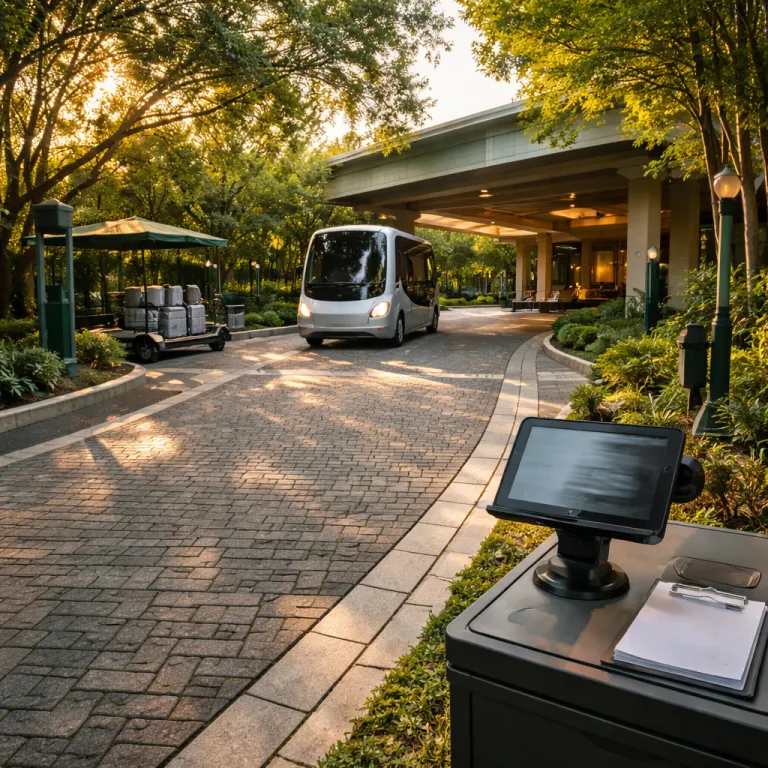
On the ground, an autonomous arrival is a choreography of sensors, staff and guests, not a science fiction moment. The autonomous vehicle or autonomous shuttle approaches a geofenced arrival lane—an area digitally mapped so the AV can operate within strict boundaries—communicates its estimated time of arrival through an API, and signals curbside access needs to the hotel’s operations system. At that point, your bellhop or curbside host becomes the human interface between autonomous driving systems and a tired traveler who just wants the ride to be over.
In a mature setup, the hotel autonomous vehicle policy defines exactly where AVs may stop, how long they may dwell and how luggage transfer is handled. Some properties already designate specific AV bays, separate from traditional taxi and ride-hailing queues, to avoid confusion between autonomous rides and vehicles with a human driver. To make this operationally robust, many legal and risk teams now recommend codifying details such as maximum dwell times, minimum clearances from doors and fire lanes, and whether AVs may queue on public streets during peak periods. This separation matters because liability transfer points differ: with autonomous vehicles, the moment when the guest steps out and the hotel accepts custody of luggage or equipment must be crystal clear in both internal procedures and guest-facing communication.
Geofenced zones also change how travel managers and mobility platforms think about routing and long-distance connections. An AV arriving from an airport or a rail station might be constrained to a specific side street, forcing hotels to rethink signage, lighting and even the placement of doormen to maintain a premium hospitality experience. Over time, these micro decisions about where autonomous transportation meets the building will shape future perceptions of safety, efficiency and brand quality more than the marble in the lobby.
Hotels experimenting with autonomous shuttles on large resort sites or multi-building campuses are already learning hard lessons about wayfinding and guest anxiety. When autonomous vehicles circulate between villas, conference centers and parking structures, guests need simple, human-centric instructions, not engineering jargon about levels of autonomy or controlled environments. A robust hotel autonomous vehicle policy therefore has to specify not only technical standards for AVs, but also the tone, timing and channels of guest communication before, during and after each trip, including sample scripts, notification templates and clear escalation paths when something goes wrong.
The three non negotiable clauses in a hotel autonomous vehicle policy
For legal, finance and operations teams, the heart of any hotel autonomous vehicle policy lies in three clauses: insurance exposure, data sharing and branding at the curb. These clauses determine who pays when something goes wrong, who owns the data generated by autonomous mobility flows, and whose logo guests see when they step out of the vehicle. Get them wrong, and you lock your property into a decade of unfavorable terms just as autonomous transportation scales.
Insurance exposure is the first battlefield, because autonomous vehicles blur traditional lines between hotel, guest and third-party liability. When an autonomous ride operated by an external provider such as Uber Autonomous Solutions or Waymo enters your site, your policy must define the exact point at which responsibility shifts from the AV operator to the hotel. That includes slip-and-fall incidents at the curb, damage to real estate fixtures from driverless vehicles, and edge cases where a human driver supervising autonomous driving systems intervenes late. Many hotel counsel teams now specify minimum insurance limits (for example, commercial general liability of at least USD 5 million per occurrence and automobile liability of at least USD 5 million combined single limit) and require the hotel and ownership entity to be named as additional insureds on the AV operator’s policies.
Data sharing is the second clause that will define your future travel economics. Autonomous vehicles and autonomous shuttles generate rich data about arrival times, trip origins, dwell durations and even luggage volumes, all of which can inform staffing, upsell strategies and long-distance transfer partnerships. A strong policy should secure hotel access to aggregated, anonymized AV data while respecting privacy regulations, because without that visibility, you are flying blind on one of the most valuable operational datasets in the hospitality industry. Typical schedules now list specific data fields—such as timestamped arrival and departure, pick-up and drop-off zones, vehicle type, party size, trip distance band and payment channel—and set retention periods (for example, 24–36 months for operational analytics, shorter for any data that could be linked back to an identifiable guest).
Branding at the curb is the third clause that too many hotels treat as an afterthought. As AV fleets scale in cities like San Francisco and beyond, the curb becomes a contested media surface where mobility brands, airlines, rail operators and hotels all want presence. Your hotel autonomous vehicle policy should specify whether AVs may display in-app offers for competing hotels when dropping guests, how your own brand appears in AV interfaces, and whether co-branded autonomous transportation services can be marketed as part of the overall hospitality experience. Clear rules on logo placement, co-marketing approvals and use of property imagery in AV apps help protect long-term brand equity.
To make these clauses concrete, consider a sample insurance and indemnity provision that can be adapted into your own contracts: “Responsibility for guest safety and property damage remains with the autonomous vehicle operator until the guest has fully exited the vehicle, crossed the designated safety line and a hotel representative has acknowledged receipt of the guest and any luggage. From that point, liability transfers to the hotel in accordance with existing premises and baggage policies. The AV operator shall maintain, at its sole cost, commercial general liability and automobile liability insurance with limits of not less than USD 5,000,000 per occurrence, naming Hotel, Owner and their affiliates as additional insureds on a primary and non-contributory basis. Operator shall defend, indemnify and hold harmless Hotel, Owner and their respective officers, directors and employees from and against all claims, losses and expenses arising out of or related to the operation of autonomous vehicles on or to the property, except to the extent caused by the gross negligence or willful misconduct of Hotel.” Language at this level of precision turns abstract AV risk into a manageable, auditable process.
Financial impact, early lessons and a 90 day policy checklist
Finance teams should treat autonomous mobility as a new P&L line, not a marginal service tweak. As more guests shift from traditional shuttles and taxis to autonomous vehicles and ride-hailing services, incremental transfer revenue will migrate from in-house fleets to third-party operators unless hotels renegotiate their role in the value chain. At the same time, AV-driven efficiencies in staffing, such as reduced need for overnight drivers or outsourced long-distance transfers, can lower cost structures if captured deliberately.
Early adopter hotels that ran AV pilots in the mid-2020s got two things consistently right: they involved cross-functional teams from operations, legal, IT and marketing, and they invested in AV-friendly infrastructure such as clear signage, dedicated lanes and upgraded Wi-Fi at the curb. Where they stumbled was in underestimating the change management required for staff who had spent careers coordinating with a human driver rather than an algorithm. Those pilots also showed that guests quickly normalize autonomous rides when the hospitality layer around them feels familiar, including a warm greeting, proactive luggage help and clear guidance on onward transportation options.
One city-center hotel, for example, partnered with an AV operator to replace its late-night shuttle from the main rail station. Within three months, the property reduced shuttle operating costs by more than 15 %, reallocated two full-time driver roles to guest-facing concierge positions and saw arrival satisfaction scores rise by just over 20 % for guests using the autonomous service. These figures were drawn from the hotel’s internal financial reports and guest survey data, and while they reflect a single property rather than an industry-wide benchmark, the lesson was clear: the financial upside only materialized because the hotel had a written AV policy covering curb design, staff scripts and data access before the first driverless vehicle arrived.
Over the next 90 days, any serious general manager can draft a first version of a hotel autonomous vehicle policy that will stand up at the next ownership review. A practical 90-day roadmap might include:
- Days 1–30: Map interactions and risks. Identify every touchpoint where autonomous vehicles, autonomous shuttles or other AVs might interact with your site, from airport transfers to on-property circulators and late-night ride-hailing pickups. Document current curb layouts, lighting, CCTV coverage and existing transportation contracts.
- Days 31–60: Design the service and controls. Convene a working group with representatives from hotel management, AV providers and guest experience teams to define service quality standards, safety protocols, minimum insurance limits, data fields to be shared and escalation paths for incidents involving autonomous driving systems.
- Days 61–90: Codify, train and test. Translate those decisions into a short, copy-ready template that covers the core clauses on insurance, data and branding, and align it with existing contracts for transportation, parking and real estate operations. Build simple training modules so that front-line staff understand how autonomous transportation changes their scripts, including what to say when guests ask whether autonomous vehicles are safe for hotel guests, whether all hotels offer autonomous vehicle services, or how to use a hotel’s autonomous vehicle service in practice. Finally, schedule a policy review cadence, because as AV technology, regulation and guest expectations evolve, your hotel autonomous vehicle policy will need to adapt just as quickly as the mobility landscape that is shaping future hospitality.
Key figures on autonomous vehicles in hospitality
- Around 50 % of hotels using AVs in some form report measurable adoption of autonomous vehicles in their ground transportation mix, according to recent industry reports and early pilot summaries from major hotel groups and mobility consultancies; however, most of these figures are based on self-reported survey data and limited pilot samples rather than long-term, independently audited studies.
- Properties that have integrated autonomous mobility into airport transfers and on-site shuttles have seen guest satisfaction for arrival and departure increase by approximately 20 %, based on survey data from early adopters and internal Net Promoter Score tracking; results vary significantly by market, guest segment and the maturity of the AV deployment.
- Hotels that partner with AV companies such as Waymo or Navya typically phase implementation over several years, moving from initial trials to expanded adoption and then to wider implementation across their portfolios, with each phase accompanied by updated contracts, revised hotel autonomous vehicle policies and refreshed staff training.
- Operational data from AV pilots shows that geofenced, controlled environments around hotels significantly reduce incident rates compared with mixed-traffic zones, supporting the case for dedicated AV lanes at busy properties, though exact percentages differ by city, regulatory framework and the specific autonomous driving systems in use.
Questions hospitality professionals are asking about hotel AV policies
Are autonomous vehicles safe for hotel guests? Yes, with proper safety measures and regulations. For hotel teams, that means aligning AV provider safety protocols with internal risk management, training staff on emergency procedures and ensuring that geofenced arrival zones are well lit, monitored and clearly signed. It also means reviewing incident logs with AV partners at regular intervals and updating the hotel autonomous vehicle policy when patterns emerge.
Do all hotels offer autonomous vehicle services? No, availability varies by hotel and location. Urban properties in markets with strong AV ecosystems, such as certain districts of San Francisco, are more likely to integrate autonomous transportation early, while resorts and long-distance destinations may rely on mixed fleets for several years. Travel managers should therefore treat AV availability as a differentiator rather than an assumed standard amenity.
How do I use a hotel's autonomous vehicle service? Follow the hotel's guidelines and instructions. In practice, that often involves booking through the hotel app or concierge, receiving a precise pickup point at the site, and confirming the vehicle identity in the interface before starting the ride. Many hotel autonomous vehicle policies now require clear guest instructions on verifying license plate, vehicle model and in-app confirmation codes before boarding.
What should travel managers check before recommending a hotel that uses AVs? They should review the hotel autonomous vehicle policy for clarity on safety standards, insurance coverage and data handling, and confirm that service quality benchmarks match those of traditional transportation partners. It is also wise to test an autonomous ride personally on a typical trip pattern to assess reliability and guest perception, and to request a summary of any material incidents or service interruptions over the previous 12 months.
How can airlines, rail operators and mobility platforms collaborate with hotels on AVs? By co-designing integrated autonomous mobility corridors that link terminals, stations and hotels with consistent service standards, shared data dashboards and aligned branding. Such partnerships can turn fragmented rides into a seamless door-to-door hospitality experience that benefits every actor in the travel chain, while giving each party clearer visibility into demand patterns, peak flows and guest satisfaction across the entire journey.
